
EU Pay Transparency Directive at a glance
The EU Pay Transparency Directive (2023/970) makes employers disclose salary ranges before hiring, bans questions about a candidate's salary history, and gives employees the right to see their own pay data and their colleagues' average pay for equal work. The EU-wide deadline for national governments to write this into law was June 7, 2026. By July 2026, only four countries had it fully in force: Italy, Slovakia, Lithuania, and Malta. Germany, France, Spain, and the Netherlands all missed it. If you hire in the EU, assume these rules already apply to you, even if your own country's law is still catching up.
Quick Answers
When does it apply? The EU-level deadline was June 7, 2026, and it's already passed. Whether it's enforceable where you are depends on your own country's law. Some countries have it. Most don't, yet.
Does every job ad need a salary? Where the law is in force, yes. A range or a starting figure, and candidates should see it before the interview, not after they ask for it.
Can employers ask about previous salary? No. This is one of the few parts of the Directive that isn't optional, scaled by company size, or left open to interpretation.
Who is affected? Any employer whose workers are covered by an EU member state's employment law. That includes remote-first companies outside the EU hiring EU-based staff.
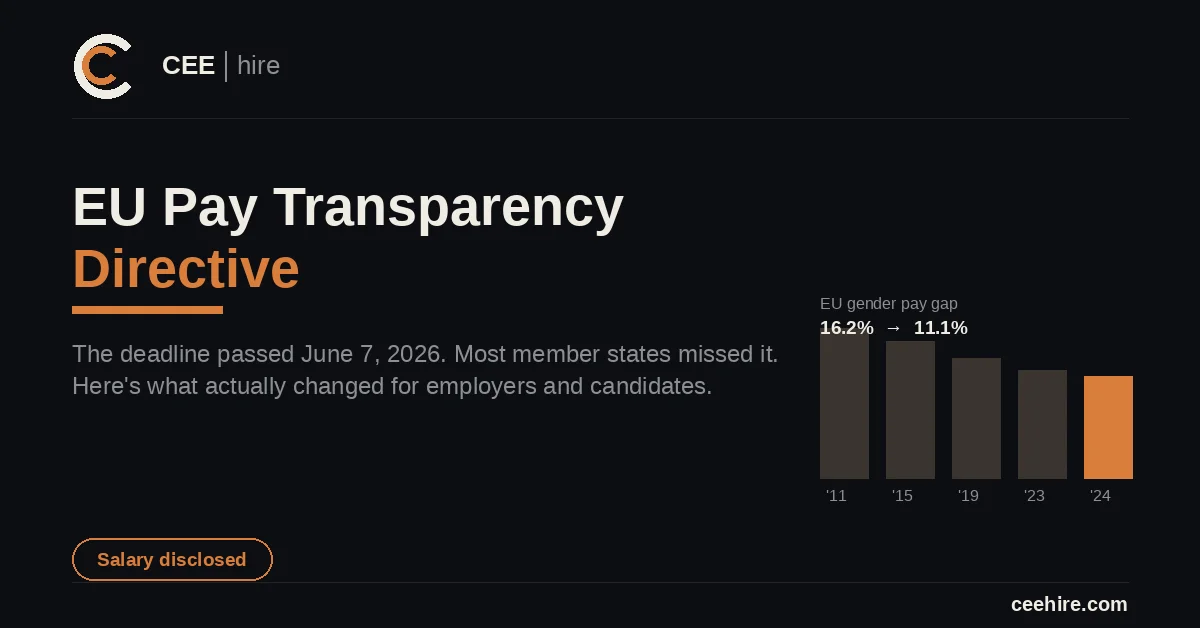
Why was the Directive introduced? To close the EU's gender pay gap, which stood at 11.1% in 2024. That's down from 16.2% in 2011, but still means women in the EU earn roughly 11 cents less per euro than men, on average.
What Changed, in Plain Terms
The Directive bundles four separate changes into one law:
Salary information in job ads. Employers must tell candidates the starting salary or salary range before the first interview — not during negotiation, not after an offer.
No more salary history questions. Recruiters and hiring managers can't ask what a candidate earned in a previous role. The goal: stop old pay gaps from following people into new jobs.
No pay secrecy clauses. Employment contracts can no longer ban employees from discussing what they earn with colleagues.
Pay data and audit rights. Employees can request their own pay level and the average pay of colleagues doing equal work. Employers with 100+ employees must report gender pay gap data; if the gap is 5% or more and can't be explained by objective, gender-neutral criteria, they must run a joint pay assessment and fix it within six months.
Definitions
What is salary transparency?
Salary transparency is the practice of openly sharing compensation information — salary ranges, pay structures, or the criteria used to set pay — during recruitment and throughout employment.
What is pay equity?
Pay equity means employees performing equal work, or work of equal value, receive equal pay regardless of gender. "Equal value" is assessed using objective, gender-neutral criteria: skills, effort, responsibility, and working conditions.
What is salary history?
Salary history is what a candidate earned in a previous job. Under the Directive, employers can no longer ask candidates about it during recruitment — the offer has to stand on the role's value, not on what someone was underpaid before.
Key Takeaways
Employers must share salary information before candidates get to the interview stage, not after.
Salary history questions are banned outright — no exceptions by company size.
Pay decisions need to trace back to objective, gender-neutral criteria, not "market rate" hand-waving.
The rules already apply in some EU countries and are still pending in others — check your specific country's transposition status, don't assume based on the EU-wide deadline.
Transparency tends to build trust faster, too. Fewer candidates bail late in the process over a salary mismatch nobody mentioned earlier.
Example: Before and After
Before
Software Engineer Competitive salary Remote
After
Software Engineer Salary: €55,000–€65,000 Remote (EU-based) Annual bonus, private healthcare, learning budget
The "after" version isn't just compliant — it converts better. Candidates self-select in or out before they spend an hour in an interview, which saves everyone's time.
Where Things Actually Stand (July 2026)
Most articles about this Directive stop at "here's the law." Here's where it actually stands, country by country.
Status | Countries |
|---|---|
Full implementing law in force | Italy, Slovakia, Lithuania, Malta |
Partial transposition already binding | Poland (recruitment-stage rules), Czechia (salary-history and pay-secrecy bans), Belgium (public sector, French Community) |
Missed the deadline, law pending | Germany, France, Spain, Netherlands, Sweden, Denmark, Finland, Ireland, Portugal, Austria, Hungary, Luxembourg |
The European Commission has said the deadline isn't moving. Countries that haven't notified Brussels of their transposition are now formally in breach of EU law, which can trigger infringement proceedings. That's a headache for governments, not a loophole for employers. Most employment lawyers are telling their clients to comply with the Directive's substance now, regardless of what their own country's paperwork looks like.
Comparison Table
Before Directive | After Directive |
|---|---|
Salary hidden until offer stage | Salary shared before interview |
Salary history asked routinely | Salary history questions prohibited |
Pay set by who negotiates harder | Pay set by objective, gender-neutral criteria |
Colleagues couldn't discuss pay | Pay secrecy clauses unenforceable |
For Employers: How to Prepare
Review current compensation policies against the four core requirements above.
Build salary bands for every role, even ones you're not actively hiring for.
Train hiring managers and recruiters to stop asking about salary history — it's an easy habit to break late.
Update job ad templates to include a range by default.
Remove any pay secrecy language from employment contracts and offer letters.
Run an internal pay equity audit before a regulator or employee request forces the timeline.
For Candidates: What Job Seekers Should Do
Compare salary ranges across postings, not just headline numbers.
Look at total compensation — bonus, benefits, learning budget — not just base salary.
Ask direct questions about pay structure in early conversations; it's your right, not an imposition.
Research market salaries for your role and country before you're in a negotiation.
Don't rely on negotiation skill alone to close a pay gap that transparency is supposed to fix for you.
FAQ
Is salary transparency mandatory? Yes, under EU law. Whether it's enforceable where you're hiring depends on whether your country has actually passed its own version of it yet.
Does it apply to startups? Yes, though reporting obligations scale with company size: gender pay gap reporting kicks in at 100+ employees, with fuller annual reporting for companies over 250.
Does it apply outside the EU? No — but it applies to any employer, EU-based or not, with workers covered by an EU member state's employment law. A US company employing someone in Poland is in scope for that employee.
Can recruiters discuss salary expectations? Yes. Asking what a candidate expects to earn is fine. Asking what they earned before is not.
Can employers negotiate salary? Yes, within the disclosed range. The Directive sets a floor of transparency, not a ban on negotiation.
What happens if employers don't comply? Penalties are set at the national level and vary by country — typically fines, and in some jurisdictions, exposure to pay discrimination claims with a reversed burden of proof.
Does the Directive affect remote jobs? Yes, if the employment relationship is governed by an EU member state's law — which is common for remote roles held by EU-based employees, regardless of where the employer is headquartered.
Does it apply to contractors? Generally, the Directive covers "workers" as defined under national employment law, which usually excludes genuine freelancers and contractors. This varies by country — check local rules if your workforce includes contractors, since misclassification is a separate risk in itself.
What is considered equal work? Work of equal value, judged on objective, gender-neutral criteria: skills required, effort, responsibility, and working conditions — not job title alone.
Will salary ranges become mandatory in every country? Eventually, yes, as national transposition catches up. Timelines vary — some countries are already enforcing this, others are targeting 2027.
What's the penalty for missing the deadline as a country, not a company? The European Commission can open infringement proceedings against member states under Article 258 TFEU. That's a state-to-state legal process — it doesn't excuse individual employers from complying with the Directive's intent.
Is this the same as equal pay law? It's related but broader. Equal pay for equal work has been EU law since the 1957 Treaty of Rome. The Pay Transparency Directive adds the reporting, disclosure, and audit mechanisms needed to actually enforce it.
Do part-time or fixed-term employees count? Yes. The Directive doesn't carve out part-time, fixed-term, or agency workers from its core disclosure and non-discrimination provisions.
Where can I check my country's specific rules? National transposition status changes month to month. Check your country's labor ministry site or talk to local employment counsel before finalizing hiring templates — this article is a starting point, not a compliance sign-off.
TL;DR
Salary ranges in job ads. No more questions about what you used to earn. Pay decisions that have to hold up to scrutiny, not just tradition. That's the EU Pay Transparency Directive in practice, and it's already law at EU level, even though most countries haven't finished writing it into their own books yet. Don't wait for your government to catch up before you do.
This article is for general information, not legal advice. Pay transparency obligations vary by country and change frequently during this transposition period. Confirm current rules with local employment counsel before updating your hiring policy.
Related posts
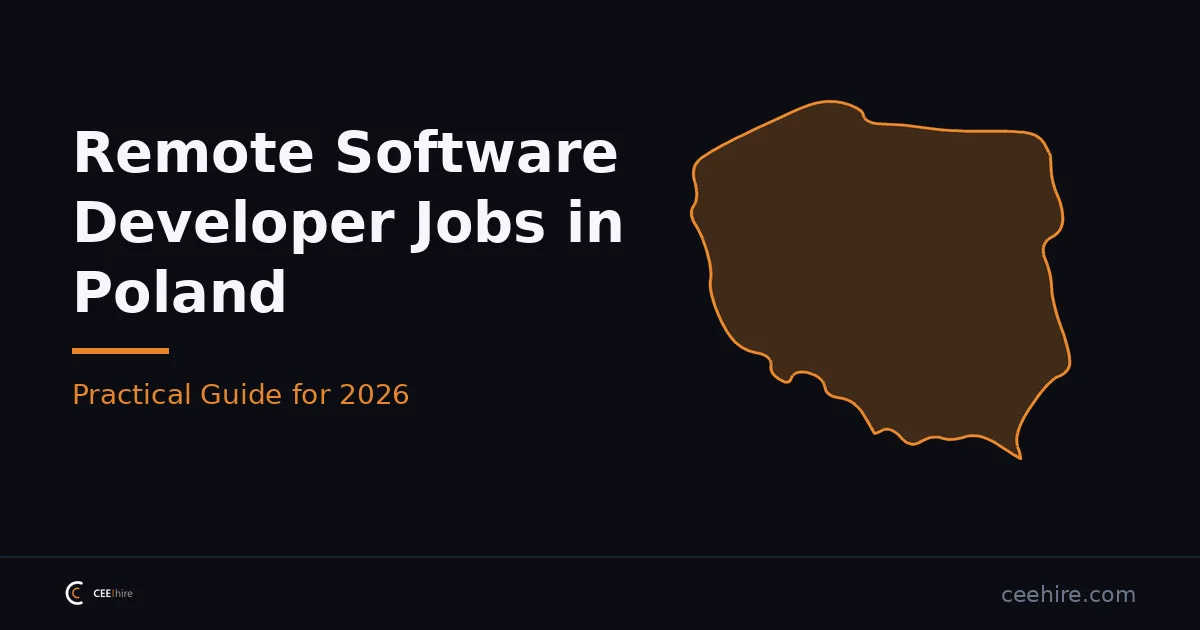
Polish developers don't need convincing that remote work exists — half the senior market already invoices on B2B. The real questions in 2026 are different: which international roles are actually open to someone billing from Warsaw or Wrocław, what US and UK companies pay compared to the local PLN 25,000–27,000 senior benchmark, and whether ryczałt, liniowy, or IP Box leaves more in your pocket. This guide answers those, with data from No Fluff Jobs, Just Join IT, and regional salary reports.
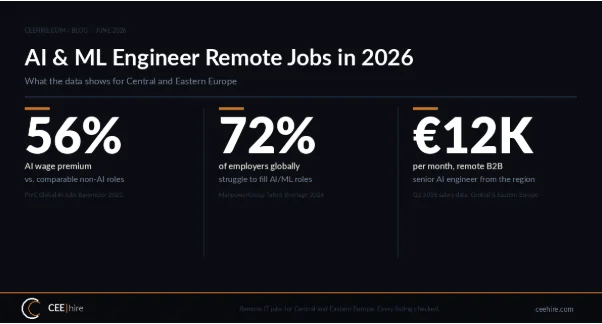
72% of employers globally cannot fill AI and ML roles. The wage premium for AI skills sits at 56% above comparable non-AI work and is climbing. Remote AI and ML engineer roles paying €6,000–€12,000 per month are not aspirational — they are what the Q2 2026 salary data shows for developers in Central and Eastern Europe working for US and UK companies. The problem is not the pay. The problem is finding the roles that are actually accessible from this side of the map.

What do current DevOps listings on CEEhire actually show? Salaries range from €3,400 to €14,000/month depending on company type, and Azure is just as active as AWS in CEE-accessible roles. Here's the breakdown.