
Data has overtaken JavaScript. That's the single most telling fact about the Polish IT market in 2026: for the first time, Data is the largest hiring segment on No Fluff Jobs, at 10.78% of all open positions, and new IT job postings grew 44% year over year. AI and ML specialists lead wage growth at 15–25% annually. Senior engineers in that segment field three to five recruiter approaches a month.
So why write a remote-work guide for the one country in Central and Eastern Europe that least needs convincing?
Because the Polish market has a specific problem: maturity hides the gap. Local B2B rates are good — good enough that many seniors stop looking. And the listings that would pay 30–80% more sit on international boards, mixed in with thousands of roles that were never open to anyone outside the US. I spent seven years recruiting IT professionals across this region. The pattern I saw in Poland wasn't developers failing interviews. It was developers never finding the interviews worth their time.
Here's the 2026 picture for Polish developers — Frontend, Backend, DevOps, Full-Stack, QA, Data — with numbers you can check.
The three kinds of "remote" in your search results
Internationally accessible remote. The company hires across borders, runs payroll or contractor invoicing in multiple countries, and doesn't blink at a Polish B2B invoice — plenty have paid one before. Warsaw works at UTC+1/+2: full Western European overlap, five to six workable hours with the US East Coast. These are the listings worth your attention.
EU-remote. The company stays within the EU for legal or tax reasons. Poland qualifies, full stop. The catch: some companies write "EU remote" and quietly mean Western EU. With Poland this happens less than with smaller markets in the region — Polish contractors are a known quantity — but ask if the listing doesn't spell it out.
Remote-ish. Remote within one country. Remote with a monthly office day in Berlin. Remote until a new VP changes the policy. Not dishonest, exactly. Not accessible from Gdańsk either.
General job boards mix all three, because volume drives their traffic and the sorting is left to you. CEEhire works the other way: every listing is checked by hand before it goes live, and geographic accessibility is the first filter.
What the Polish data says about roles
Poland is the one market in Central and Eastern Europe with publicly available, granular hiring data, so this section can be sharper than guesswork.
Data engineering and AI-adjacent work lead the market. Not research ML — those roles are rare everywhere and tend to want a PhD. The demand is for engineers who ship with AI tooling: LLM APIs, RAG pipelines, agents, the product layer on top of models. Python developers who can wire OpenAI or Anthropic calls into production systems sit in the strongest negotiating position of their careers.
Frontend (React/TypeScript) remains the highest-volume segment for junior and mid roles — and the most crowded. TypeScript is assumed, not a differentiator.
Backend (Python, Node, Go) stays steady, with Go pulling a premium for cloud infrastructure work.
DevOps and platform engineering is chronically short of candidates. Kubernetes, Terraform, AWS or GCP — companies hire this remotely as a matter of course, and rates show it.
Full-stack profiles dominate at remote-first startups, where one engineer who ships across the stack beats two specialists on a seed budget.
QA automation (Playwright, Cypress) travels well; manual QA mostly doesn't.
Money: local benchmarks vs. international remote
The local benchmark first, because in Poland it's the negotiating floor, not a separate world. Senior developers on B2B in Warsaw or Kraków invoice PLN 25,000–27,000 net monthly — about €5,800–€6,300. Employment-contract seniors run PLN 19,000–28,000 gross. Juniors start at PLN 7,000–10,500 gross.
International remote contracts, annualized:
Role | Experience | Approximate annual range (EUR) |
|---|---|---|
Frontend Developer (React/TS) | 2–4 years | €38,000 – €62,000 |
Frontend Developer (React/TS) | 5+ years | €62,000 – €95,000 |
Backend Developer (Python/Node/Go) | 2–4 years | €42,000 – €66,000 |
Backend Developer (Python/Node/Go) | 5+ years | €66,000 – €100,000 |
Full-Stack Developer | 3–5 years | €48,000 – €78,000 |
DevOps / Cloud / Platform | 3+ years | €60,000 – €110,000 |
Go / Rust Engineer | 3+ years | €65,000 – €115,000 |
AI / ML-adjacent Engineer | 3+ years | €70,000 – €130,000 |
Data Engineer | 3+ years | €52,000 – €90,000 |
QA Automation | 3+ years | €40,000 – €65,000 |
Sources: No Fluff Jobs 2026 market report, Just Join IT salary data, Nortal 2026 IT salaries guide for Central and Eastern Europe, VeritaHR Poland Salary Guide 2026.
At the top of the market, senior B2B rates for AI specialists reach PLN 42,000–65,000 a month — €10,000–€15,000. Real, not typical.
Worth knowing: Poland has the smallest local-to-remote pay gap in Central and Eastern Europe, precisely because the local market matured first. A senior in Bucharest doubles their income by going international; a senior in Warsaw gains 30–80%. Still the best raise available without changing what you do all day.
JDG, ryczałt, IP Box: the contractor mechanics
Poland's B2B culture is the most developed in the region, and the tax system is the reason. If you're new to it, the moving parts:
The vehicle is a JDG — jednoosobowa działalność gospodarcza — registered online through CEIDG in a day. Your foreign client needs no Polish entity; you invoice monthly and handle your own taxes and ZUS.
The tax choice is where Polish contractors differ from everyone else in Central and Eastern Europe, because there are three regimes and the right one depends on your numbers:
Ryczałt — lump-sum tax on revenue, 12% for most software services (8.5% for some). No expense deductions, minimal accounting. The default for developers with a laptop and low costs.
Podatek liniowy — flat 19% on profit, expenses deductible. Wins when your costs are real.
IP Box — 5% on qualifying income from software you create. Demands per-project documentation and an accountant who knows the regime, and not every B2B contract qualifies. When it fits, nothing else in the region comes close.
An accountant runs PLN 200–600 a month for a solo JDG and pays for themselves in the regime choice alone.
Misclassification exists here too: one client, fixed hours, direct supervision reads as employment. Deliverables-based contracts keep the structure clean. And US clients will hand you a W-8BEN form — two minutes of work, and having it ready marks you as someone who's done this before.
The EOR alternative: if a company insists on employing you rather than contracting, an Employer of Record (Deel, Remote.com, Rippling, Remofirst, Native Teams — all active in Poland) hires you locally on their behalf. You get umowa o pracę benefits and zero invoicing; you give up the net-income advantage of ryczałt or IP Box, which in Poland is a bigger sacrifice than elsewhere in the region. Most Polish seniors pick B2B when given the choice. Ask which structures a company supports before the second interview, not after the fourth.
Where the real listings are
CEEhire — every listing verified by hand as accessible from Central and Eastern Europe, Poland included.
No Fluff Jobs — the strongest local board: mandatory salary ranges, honest remote labels. Its weakness is the flip side of its strength — mostly Polish and regional employers, fewer US/UK direct contracts.
Just Join IT — high volume, salary transparency, strong B2B coverage. Same regional skew.
We Work Remotely, Remote OK — where the international roles live, mixed with everything that says "remote" and means Boise, Idaho. Read the location fine print on each listing.
LinkedIn — best used for research and direct outreach, not its remote filter, which ignores geographic eligibility.
Direct outreach — at senior level, often the shortest path. Remote-first companies publish their hiring geographies; find the engineering manager, write three sentences about their stack, skip the "open to opportunities" boilerplate.
Ghost jobs: the 20–30% you can't see from the listing
LinkedIn's own research estimates that a fifth to a third of postings at any moment are ghost jobs — filled long ago, never budgeted, or "pipeline building." The listing stays up because it costs nothing and feeds the employer brand.
Checks that take one minute and save a week:
Posting age. Sixty days untouched usually means filled or fictional.
Hidden geography. Search the listing text for "must be located in" and "authorized to work." Sometimes the restriction appears only in the application form.
Missing overlap hours. Serious remote employers state expected timezone coverage. Silence is a question you ask before applying.
"Occasional travel," undefined. Once a year is a team offsite. Once a month from Kraków is a commute with extra steps.
No company name. Occasionally stealth-mode, more often a recruiter hiding a restriction you wouldn't like.
CEEhire's answer to ghost jobs is procedural: every role is confirmed with the company before listing, and removed when it fills.
Positioning, the Polish edition
Write better than you talk. Remote companies run on pull requests, Slack threads, and design docs. Polish engineers carry a strong technical reputation internationally; written English is where applications still leak. A clean GitHub README does more than a certificate.
Sell the overlap, not the location. "Warsaw, UTC+1 — full EU overlap, mornings with New York" answers the question a hiring manager is silently asking.
Bring proof. Code on GitHub, a contribution history, a side project with users. At senior level it's expected; at mid level it separates you from the React crowd.
Have the JDG ready. Registered, regime chosen, accountant on call. "I can invoice from day one" shortens negotiations.
Name your target. "Backend, Python or Go, product company, async culture" gets responses. "Open to anything remote" gets archived.
Frequently asked questions
Can a developer in Poland legally work for a US company? Yes — as a JDG contractor invoicing the US client from Poland, paying Polish taxes. No US permit applies because the work happens in Poland. The client collects a W-8BEN form from you. Standard, widely used; confirm your specifics with an accountant.
Ryczałt, liniowy, or IP Box — which one? Low costs and straightforward services point to ryczałt at 12%. Real deductible expenses point to liniowy at 19% on profit. Software you create under a properly documented contract can qualify for IP Box at 5% — the best deal anywhere in Central and Eastern Europe, and the one that most needs professional setup. Run all three against your actual numbers with an accountant.
Is B2B worth it over umowa o pracę for remote work? For most seniors, yes — B2B yields roughly 13–26% more net than an equivalent employment contract before the IP Box even enters the math. The trade is self-managed ZUS, no paid leave by default, and contract risk. EOR employment is the middle path when a company won't contract.
Do I need to be in Warsaw? No. Warsaw pays 10–20% more locally at junior and mid level, but international remote rates are city-blind. Wrocław, Gdańsk, Poznań, or a village with fiber — the invoice reads the same.
How long until the first international contract? Seniors with a portfolio and clear positioning: five to twelve weeks. Juniors without remote history: two to four months, with the portfolio doing most of the work.
Where to start
Browse the verified remote listings accessible from Poland on CEEhire. Every role is checked before it goes live — no geographic dead-ends, no six-month-old ghosts.
New roles are added all the time. If today's list doesn't fit, tomorrow's might.
Related posts
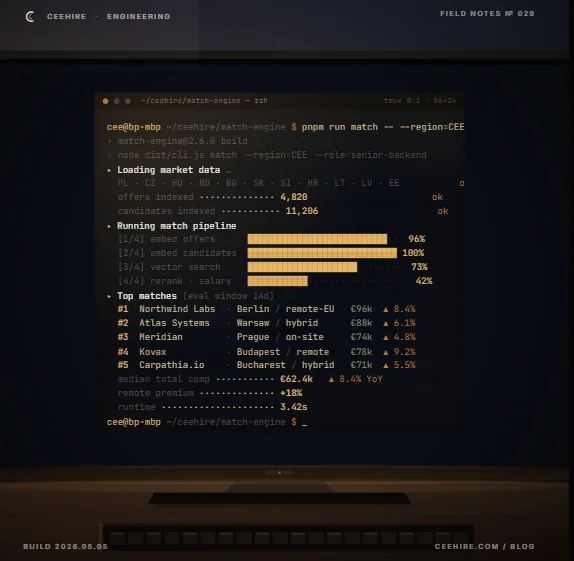
The IT job market in Central and Eastern Europe isn't dead, it's uneven. Junior frontend is crowded. But for DevOps, cybersecurity, data engineering, and backend work, US and EU companies are still hiring faster than the talent pool can keep up with. Here's where the demand actually is in 2026.

AI hiring is changing Agentic AI isn’t the only area seeing strong growth. Demand for GenAI Solutions Architects and AI Product Owners increased by 120%, while demand for LLM Engineers rose by 86.5% and MLOps Engineers by 82.2%. At the same time, AI is taking over more routine technical work. According to the analysis, it can already handle up to 70% of routine ticket resolution and reporting tasks and automate around 65% of test-case creation.
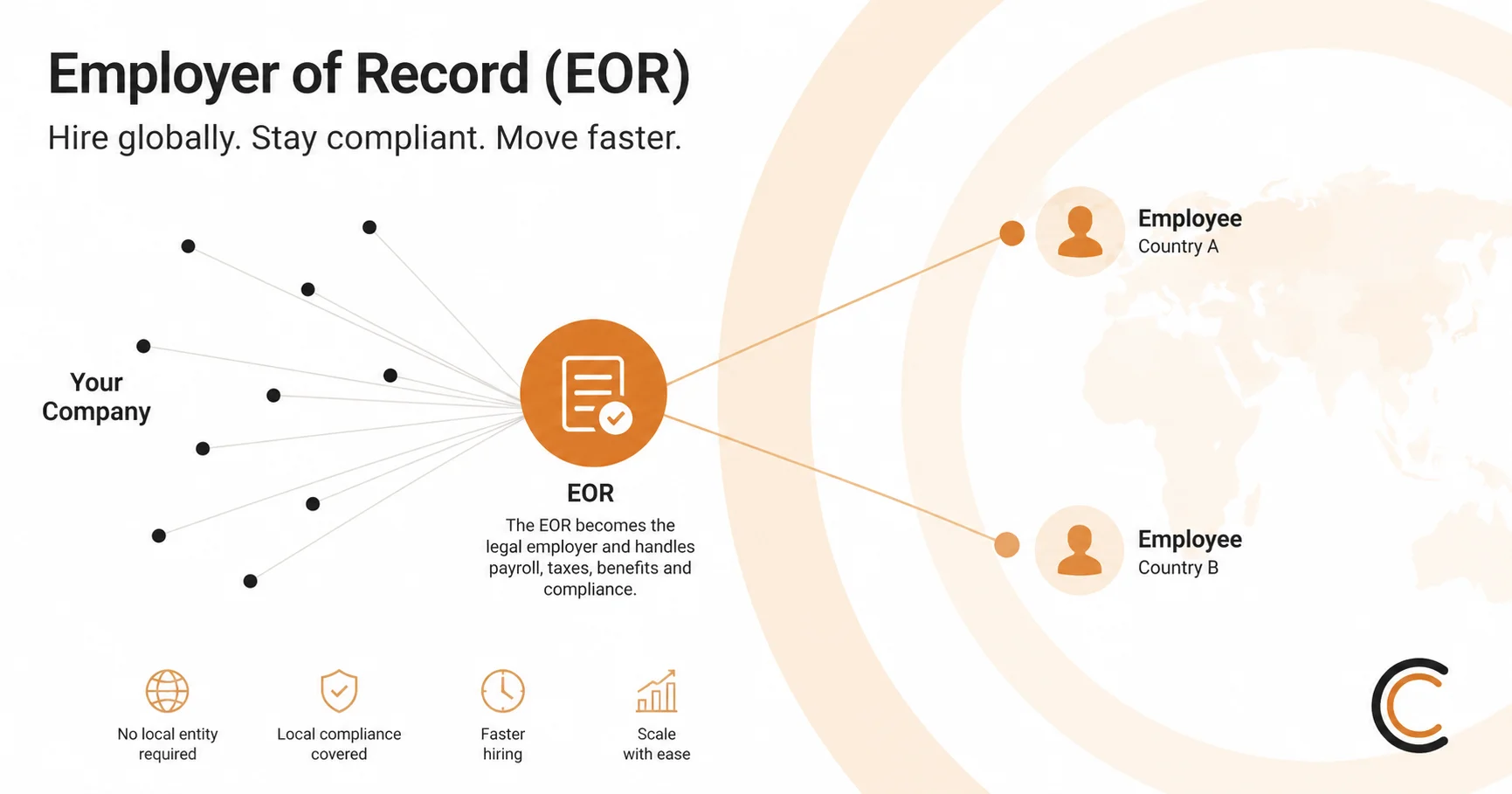
What is an Employer of Record, how does it work, and when does it actually make sense for hiring CEE tech talent? A practical 2026 guide — plus the leading EOR providers compared.