
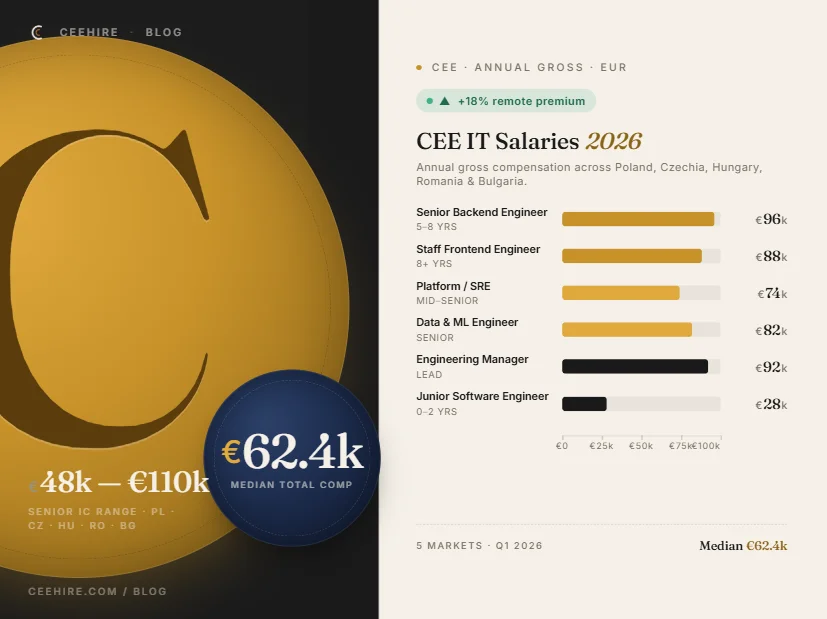
Every quarter, developers across Central and Eastern Europe post their salaries anonymously in community threads. The r/programare Q2 2026 salary thread alone collected dozens of verified responses from Romanian engineers. We combined that data with published 2026 salary guides from across the region to put together an honest picture.
The gap no one talks about enough
A senior backend developer working for a Romanian or Hungarian company earns between €2,800 and €3,500 per month in 2026. The same developer, same skills, same timezone, working remotely for a US or UK company, earns €5,000 to €10,000.
That gap is real. And it is why remote matters.
This post covers what local markets pay, what the remote premium looks like, and which roles command the highest rates in the region right now.
Romania
Romania's tech market is split in two. Outsourcing companies (the Endavas and Cognizents of the world) pay significantly less than product companies or direct-hire international employers.
2026 salary benchmarks, net per month:
Seniority | Local/outsourcing | Product company / remote |
|---|---|---|
Junior (0–2 yrs) | €1,000 – €1,300 | €1,200 – €1,600 |
Mid (2–5 yrs) | €1,600 – €2,400 | €2,400 – €3,200 |
Senior (6+ yrs) | €2,800 – €3,400 | €4,000 – €6,000+ |
From the Q2 2026 community thread, real reported figures include:
DevOps engineer, 2.5 years experience: €2,160 net
Java developer, 3 years: €1,600 net
Senior JavaScript developer, 6 years, remote: €5,600 net
Cybersecurity engineer, remote: €3,710 net
Backend AI/Python engineer, 4 years, two B2B contracts: €12,000 net
The last one is not a typo. AI specialization at 4 years of experience, on B2B contracts, produces numbers that look like Western European salaries. This is the fastest-moving segment of the Romanian market right now.
What drives salaries up in Romania: Working directly for a US or UK company (not through an outsourcer), switching from employment contract to B2B/SRL/PFA, and specializing in AI, DevOps, or cybersecurity. The combination of all three produces the outliers at the top of the table.
Poland
Poland is the salary leader in the CEE region. Senior developers on B2B contracts in Warsaw or Kraków invoice PLN 25,000–27,000 net per month, which is around €5,800–€6,300. Even on employment contracts, senior salaries exceed €2,800 net.
2026 benchmarks, monthly (EUR approximate):
Seniority | Employment contract | B2B contract |
|---|---|---|
Junior | €1,700 – €2,100 | €2,000 – €2,500 |
Mid | €2,800 – €4,000 | €3,500 – €5,000 |
Senior | €4,000 – €6,000 | €5,500 – €8,000+ |
AI and ML roles in Poland are growing 15–25% year over year. Data engineers and ML engineers at senior level cluster around €8,000–€9,500 total employer cost per month according to Nortal's 2026 CEE guide.
Poland also has a significant tax advantage for developers on B2B: the IP-box regime allows 5% income tax on qualifying software income. That pushes net take-home well above what employment contract figures suggest.
Czech Republic
Czechia sits between Poland and Hungary in terms of pay. The typical monthly range for IT professionals runs from €1,730 at junior level to just under €5,000 for the best-paid senior roles.
2026 benchmarks (monthly, EUR):
Seniority | Monthly (EUR) |
|---|---|
Junior | €1,730 – €2,200 |
Mid | €2,500 – €3,500 |
Senior | €3,800 – €4,930 |
Senior data scientists and ML engineers are the highest earners, with annual figures reaching €48,000+ gross. Prague adds a modest premium over regional cities, though remote work has softened that gap.
Hungary
Hungary offers competitive salaries relative to its cost of living, with senior IT professionals earning €3,300–€4,200 per month and junior developers starting around €1,800–€2,000.
2026 benchmarks (monthly, EUR):
Seniority | Monthly (EUR) |
|---|---|
Junior | €1,800 – €2,200 |
Mid | €2,400 – €3,200 |
Senior | €3,300 – €4,500 |
Budapest dominates the market, though fully remote roles have opened up salaries from international employers to developers outside the capital too. Hungarian developers working remotely for Western companies can push well above the local senior ceiling.
Bulgaria
Bulgaria's local market pays below the regional average. But Bulgarian developers on B2B contracts with international clients tell a different story.
2026 benchmarks:
Seniority | Local (EUR/month) | Remote/B2B (EUR/hour) |
|---|---|---|
Junior | €1,000 – €1,400 | – |
Mid | €1,600 – €2,300 | €20 – €30/h |
Senior | €2,300 – €3,500 | €35 – €46/h |
At a senior contractor rate of €40/h, that is €6,400–€7,000 per month full-time. The gap between local employment and direct international contracts is wider in Bulgaria than anywhere else in the region.
Slovakia
Slovakia sits close to the Czech Republic in salary levels, with senior developers earning €3,500–€4,500 per month and junior roles starting around €1,500–€2,000. Detailed 2026 benchmark data for Slovakia is thinner than for the larger CEE markets, but the country follows similar patterns: outsourcing pays less, product companies and international employers pay more.
What actually drives salary in 2026
Across every country in the region, three things move salaries up:
1. Who you work for. Local outsourcing companies pay the least. Product companies pay more. Direct contracts with US or UK companies pay the most. The same developer profile can see a 2–3x salary difference depending on this single variable.
2. Contract type. B2B/SRL/PFA pays meaningfully more than employment contracts in every country. The tax advantages are real. The administrative overhead is manageable. Most senior developers in the region have already made this switch.
3. Specialization. AI, ML, and cybersecurity are pulling ahead. DevOps and cloud are close behind. Generalist roles and manual QA are growing slowly or not at all. The developers posting €10,000+ monthly figures in community threads are almost all in one of these specializations.
The remote premium, by the numbers
When a CEE developer moves from a local employer to a remote international one, the salary impact is significant:
Region | Local senior avg. (EUR/month) | Remote international avg. (EUR/month) | Delta |
|---|---|---|---|
Romania | €3,000 | €6,000 – €8,000 | +100–170% |
Hungary | €3,800 | €5,500 – €8,000 | +45–110% |
Poland | €5,000 | €6,500 – €9,000 | +30–80% |
Czech Republic | €4,200 | €6,000 – €8,500 | +43–100% |
Bulgaria | €2,800 | €6,000 – €7,500 | +115–170% |
The biggest gains are in Romania and Bulgaria, where the gap between local and international compensation is still wide. Poland has the smallest gap, partly because the local market has already matured and partly because Polish developers have been accessing international remote roles for longer.
What this means if you're looking for remote work
The salary data is clear. Working remotely for a US, UK, or EU company from your home country in Central and Eastern Europe is not just a lifestyle choice. It is a financial one.
The challenge is finding those roles. Not the ones that say "remote" but then require US residency. Not the ones posted six months ago. Not the ones where the company turns out to be a ghost.
That is the problem CEEhire is built to solve. Every role listed on CEEhire is confirmed as accessible from the countries in this guide. Salary disclosed where available. Company verified as real.
If you are looking, browse the current listings.
If you are hiring and want to reach engineers in this region, get in touch.
Sources
r/programare – Thread oficial salarii Q2 2026 (community salary thread, Romania)
VeritaHR: Poland Salary Guide 2026
https://www.laurenceandcompany.com/blog/insights-repo-5/it-salaries-in-hungary-8
Related posts
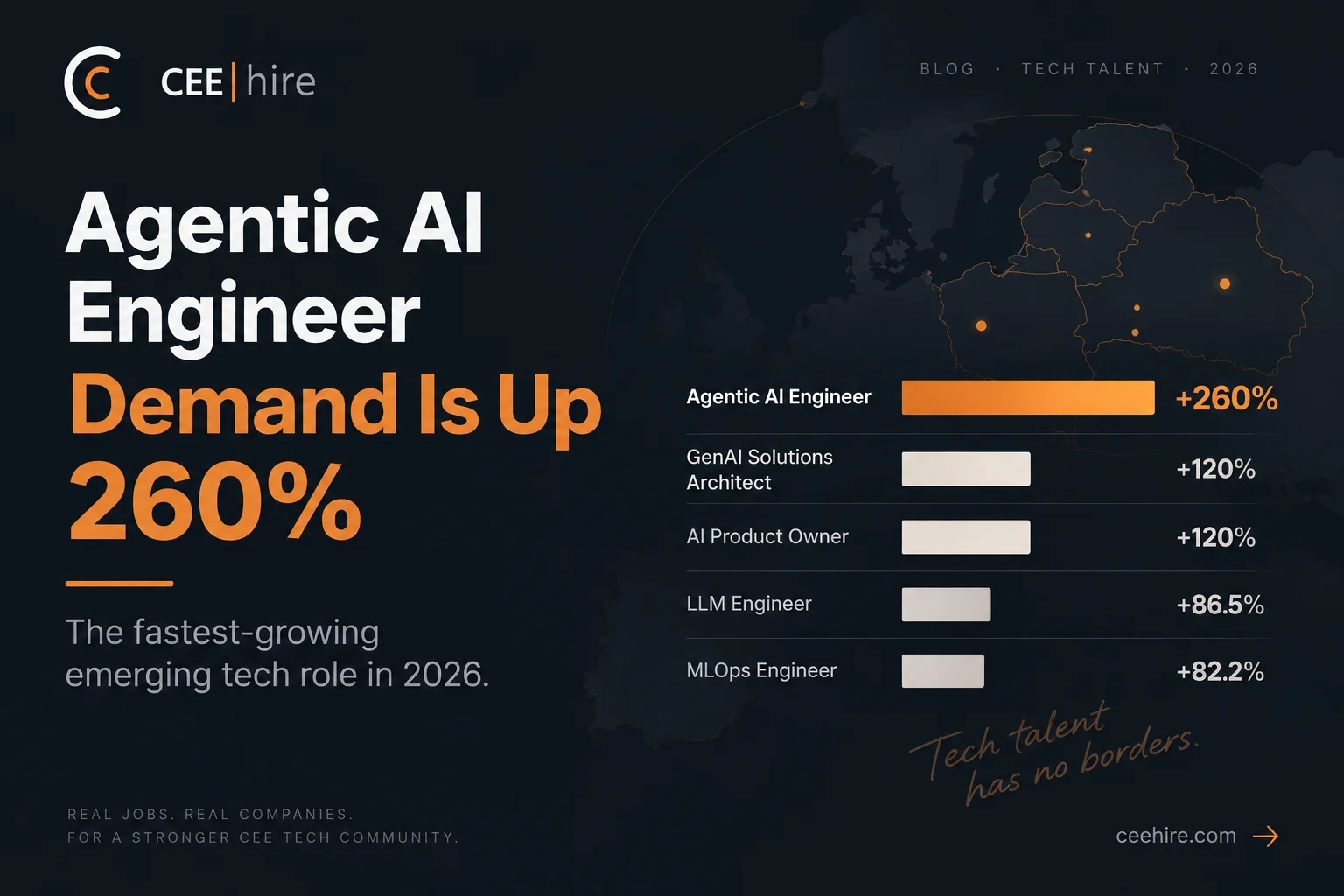
AI hiring is changing Agentic AI isn’t the only area seeing strong growth. Demand for GenAI Solutions Architects and AI Product Owners increased by 120%, while demand for LLM Engineers rose by 86.5% and MLOps Engineers by 82.2%. At the same time, AI is taking over more routine technical work. According to the analysis, it can already handle up to 70% of routine ticket resolution and reporting tasks and automate around 65% of test-case creation.
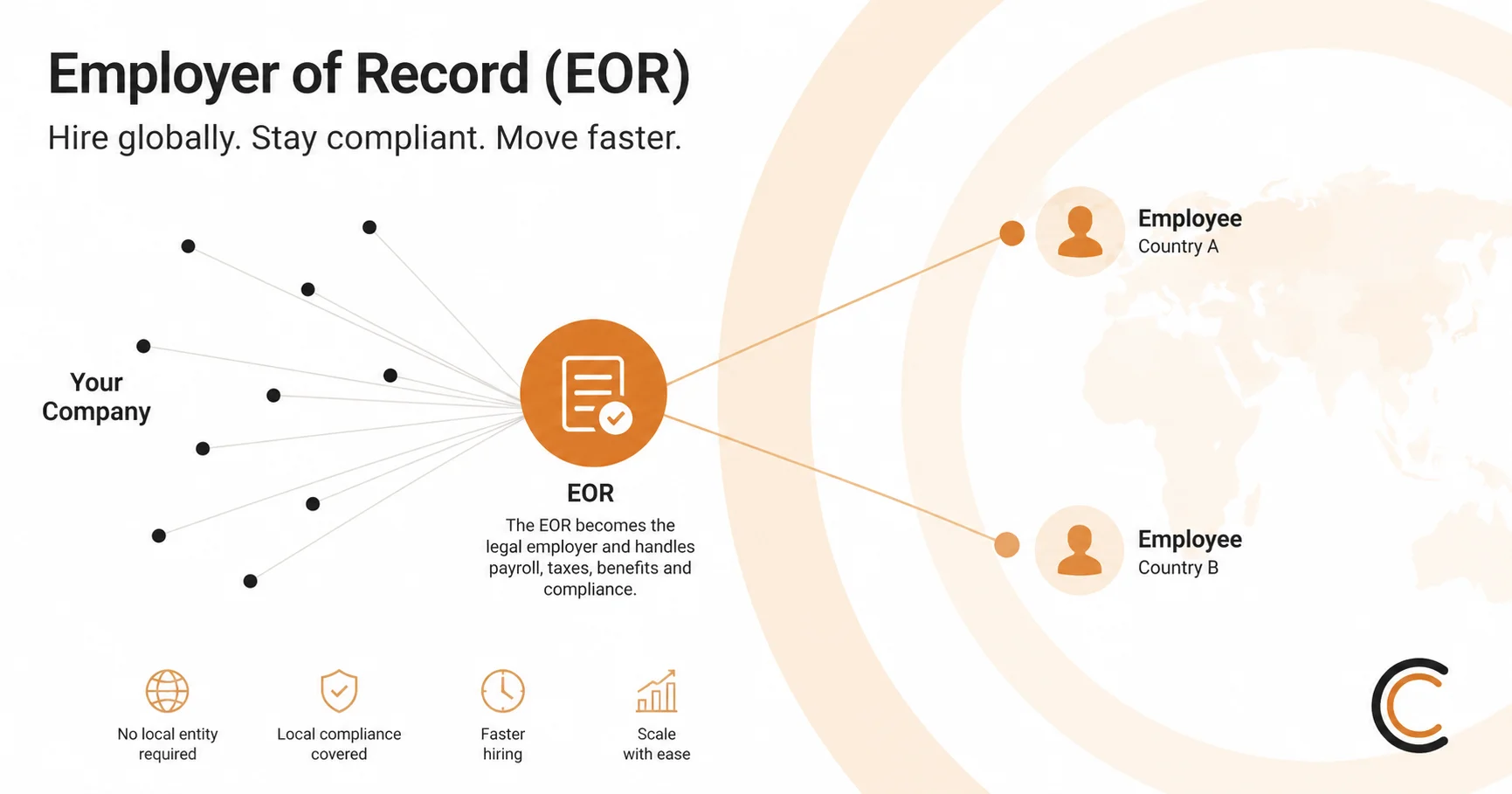
What is an Employer of Record, how does it work, and when does it actually make sense for hiring CEE tech talent? A practical 2026 guide — plus the leading EOR providers compared.

Job boards are getting harder to use for both recruiters and candidates. AI tools now apply to jobs automatically, and the usual fix, building a local network and showing up in person, gets a lot harder once the candidate and the company are in different countries.