
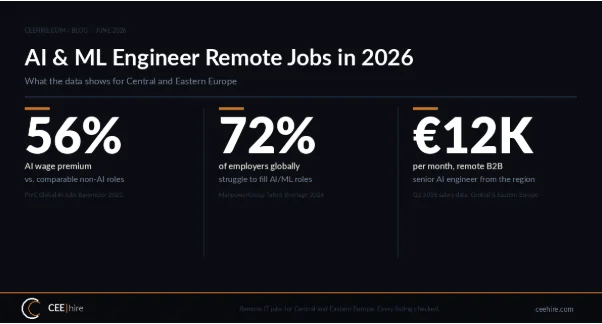
72% of employers globally cannot fill AI and ML roles. That is the headline from ManpowerGroup's 2026 Talent Shortage Survey, which covered 39,000 employers across 41 countries. For the first time, AI skills topped the list as the hardest to hire for — above traditional engineering, above IT operations, above everything.
The PwC 2025 Global AI Jobs Barometer puts the wage premium for AI skills at 56% above comparable non-AI roles. Two years ago that number was 25%. The gap is widening, not closing.
Together, those two numbers explain something most developers in Central and Eastern Europe already sense but cannot quite name: why the recruiter messages have not slowed down, even in a year when general software engineering hiring did.
What is the difference between an AI Engineer and an ML Engineer in 2026?
There is a lot of confusion in job titles here, and it is worth clearing up before looking at the market data.
An ML Engineer works at the model layer. The job is designing, training, fine-tuning, and optimizing algorithms — predictive models, classifiers, recommendation systems. It requires serious mathematical and statistical foundations. The tech stack centers on Python, PyTorch, TensorFlow, Pandas, and the infrastructure needed to move data reliably: pipelines, feature stores, batch and streaming systems.
An AI Engineer works at the application layer. This role does not typically build models from scratch. It integrates existing pre-trained models — large language models, vision systems, speech tools — into production software. LangChain, LlamaIndex, vector databases (Pinecone, Weaviate, Chroma), RAG pipelines, agentic systems built with LangGraph or CrewAI. The AI Engineer is responsible for the whole intelligent system working, end to end.
The Pave compensation database shows something interesting about how the market actually labels these roles: 83% of AI/ML positions carry an "ML Engineer" title, versus 3% with "AI Engineer." The AI Engineer category is growing fast, but the terminology still lags what the job actually is.
Neither role is purely theoretical anymore. The market draws a hard line between notebook-level work and production-level delivery. A developer who can build a model in Jupyter but cannot ship it into a monitored, scalable, containerized environment is competing in a very different pool than someone who can. MLOps skills — Docker, Kubernetes, MLflow, drift monitoring, automated retraining pipelines — command a 15–25% salary premium on top of whatever base rate the role otherwise pays. This is the gap that separates good candidates from the ones who get multiple competing offers.
How much do AI and ML engineers earn remotely in 2026?
US market first, because that is where the top remote rates come from.
The data varies significantly by source. Indeed puts the average ML Engineer base at $186,000 per year. Glassdoor is more conservative at $160,000. Levels.fyi, which skews toward Big Tech, shows a median of $190,000 base with total compensation around $262,000. At the senior level, depending on the company and location, total compensation can reach $350,000–$600,000 when RSUs are included.
For fully remote roles specifically, the national US average lands around $205,000 total compensation — lower than San Francisco or New York, but the gap has been closing for three years now.
Western Europe is more structured. Switzerland pays €180,000–€247,000 per year at senior level. Germany's industrial AI market (manufacturing, automotive, energy) runs €108,000–€140,000. The UK, with London's fintech and startup density, reaches £120,000–£165,000 for seniors.
Now, Central and Eastern Europe.
Poland's No Fluff Jobs report shows a 44% year-over-year increase in new IT job postings, and Data has overtaken JavaScript as the largest hiring segment for the first time, representing 10.78% of all open positions. The Just Join IT salary data shows AI and ML specialists leading wage growth at 15–25% annually. Senior AI/ML engineers in Poland are seeing 3–5 recruiter approaches per month and average less than 3 years in any single role. Senior remote B2B rates for AI work run from PLN 42,000 to PLN 65,000 per month — roughly €10,000–€15,000 for the right profile at the right company.
The Romanian Q2 2026 developer salary thread I referenced in an earlier post showed a backend Python developer with 4 years of experience and two B2B contracts earning €12,000 net per month. That number circulated widely because it startled people. It should not have. It is consistent with what the broader market data shows for senior AI-focused developers working for US or UK companies.
The regional pattern is consistent across Hungary, Poland, Romania, Bulgaria: who you work for matters more than where you live. A US company paying for an AI Engineer does not discount the rate because the developer is in Warsaw or Budapest. They pay for the skill.
Why is it so hard to find remote AI jobs that are actually accessible from Central and Eastern Europe?
The roles exist. The pay is real.
The problem I see, and the reason I started CEEhire, is that most job boards are not useful for developers in this region. "Remote" on most boards means "remote within the US." Or it means occasional on-site travel to a city you cannot reach without a full day of flights. Or the contract structure does not work with how individual contractors operate here. Or the company posted six months ago and quietly hired.
There is also a shadow workforce problem in Central and Eastern Europe that nobody talks about. The best senior AI and ML engineers here are largely invisible to standard job boards. They are already working for foreign companies on B2B contracts, not actively applying anywhere, and being reached directly by recruiters. If you are trying to find them by posting on a local job site, you are not going to find them.
From the company side, Central and Eastern Europe offers 40–60% cost savings compared to US or Western European hiring costs. With the talent shortage at the level it is, that math is increasingly hard to ignore — but the hiring process has to be adapted. Contract structures, timezone expectations, and onboarding assumptions need to work for professionals who are not commuting to your office.
What does CEEhire check before an AI engineer job goes live?
Every AI and ML Engineer listing on ceehire.com/jobs/ai-engineer is checked against a short list before it gets published. Timezone compatibility with Central and Eastern European working hours. Contract type — B2B, Employer of Record, or direct employment — and whether it is actually available here. Salary range, disclosed where the company has shared it. And whether the hiring process assumes you can walk into an office in San Francisco next Tuesday.
Most roles are mid or senior level. Python is the baseline. The more specialized end requires at least one of: LangChain or LlamaIndex experience, OpenAI or Anthropic API work in production, vector database implementation, agentic system architecture, or solid MLOps experience. Some are pure AI application layer. Some have stronger ML infrastructure components.
These roles move fast. A well-funded US company with a transparent salary and an EU-friendly contract does not stay open for three months.
Frequently asked questions
What is an AI Engineer and how is it different from an ML Engineer? An AI Engineer builds products using existing pre-trained models — LLM integrations, RAG pipelines, agentic systems. An ML Engineer works at the model layer: training, fine-tuning, and optimizing algorithms. The AI Engineer role is closer to production software development; the ML Engineer role requires deeper mathematical and statistical foundations.
How much can an AI or ML Engineer earn working remotely for a US or UK company from Central and Eastern Europe in 2026? At senior level, remote B2B rates typically run €8,000–€15,000 per month, depending on the company and the specific skill set. Junior and mid-level roles start lower. MLOps experience adds a 15–25% premium over base rates.
What skills do remote AI Engineer jobs require in 2026? Python is the baseline. On the AI Engineer side: LangChain, LlamaIndex, OpenAI or Anthropic API experience, vector databases (Pinecone, Weaviate, Chroma), RAG pipeline architecture, and increasingly agentic frameworks like LangGraph or CrewAI. On the ML side: PyTorch or TensorFlow, feature stores, and production deployment experience with MLOps tools.
Are remote AI jobs in Europe real, or do they require you to be based in the US? Many "remote" job listings require US residency or occasional US on-site visits. Roles that are genuinely accessible from Europe specify EU-compatible contract structures (B2B or Employer of Record), overlapping timezone windows, and hiring processes that do not assume local presence.
How severe is the global shortage of AI and ML engineers? According to ManpowerGroup's 2026 Talent Shortage Survey (39,000 employers, 41 countries), 72% of employers report serious difficulty hiring AI and ML talent — the highest rate ever recorded for this category. The PwC 2025 Global AI Jobs Barometer shows AI skills now command a 56% wage premium above comparable non-AI roles, up from 25% two years ago. Both figures point to a structural imbalance that shows no sign of closing in the near term.
Browse current AI and ML Engineer remote jobs accessible from Central and Eastern Europe: ceehire.com/jobs/ai-engineer
If you are hiring for AI or ML roles and want to reach developers in Central and Eastern Europe, get in touch.
CEEhire lists verified remote IT jobs for professionals in Hungary, Poland, Czechia, Slovakia, Romania, Bulgaria, Croatia, and Slovenia. Roles from US, UK, and EU companies, confirmed as accessible from Central and Eastern Europe.
Sources
ManpowerGroup 2026 Global Talent Shortage Survey — 39,000 employers, 41 countries
No Fluff Jobs: IT Job Market in Poland 2025/2026
Just Join IT: IT Salary Report in Poland 2026
Pave Compensation Database: AI Engineer vs ML Engineer Pay Benchmarks
Kore1: ML Engineer Salary Guide 2026
Levels.fyi ML Engineer compensation data (Q2 2026)
Glassdoor, Indeed, Built In: ML Engineer salary benchmarks (US, 2026)
r/programare: Thread oficial salarii Q2 2026 (community salary thread, Romania)
Optiveum: IT Salaries in Poland 2026
Hays Hungary Salary Guide 2026
SalaryExpert / ERI: Data Scientist, ML Engineer salaries Hungary 2026
Related posts
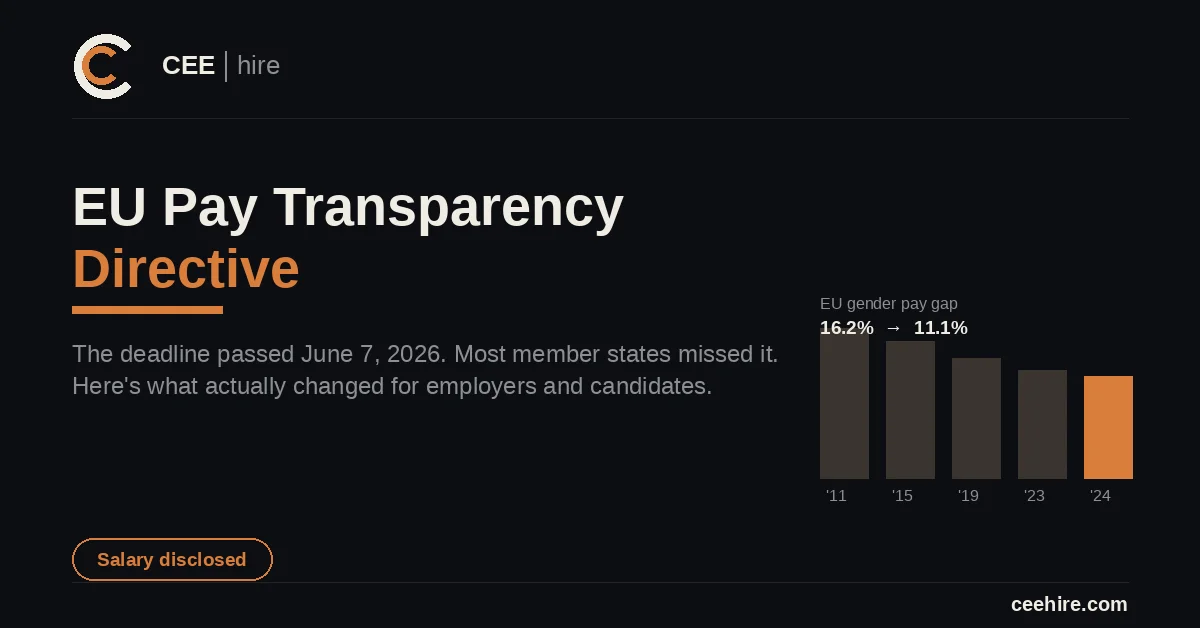
The EU Pay Transparency Directive's deadline passed on June 7, 2026, and most EU countries missed it. Here's what employers and job seekers from Central and Eastern Europe need to know right now, not "eventually."
Polish developers don't need convincing that remote work exists — half the senior market already invoices on B2B. The real questions in 2026 are different: which international roles are actually open to someone billing from Warsaw or Wrocław, what US and UK companies pay compared to the local PLN 25,000–27,000 senior benchmark, and whether ryczałt, liniowy, or IP Box leaves more in your pocket. This guide answers those, with data from No Fluff Jobs, Just Join IT, and regional salary reports.

What do current DevOps listings on CEEhire actually show? Salaries range from €3,400 to €14,000/month depending on company type, and Azure is just as active as AWS in CEE-accessible roles. Here's the breakdown.