
Poland · Hungary · Czechia · Slovakia · Romania · Bulgaria · Croatia · Slovenia
A company in the US or UK posts a remote job. You apply. You pass the interviews. They want to hire you. Then someone from HR sends an email: "We'll need to check with our legal team about hiring in your country." Two weeks of silence. Then: "Unfortunately we can't move forward."
Not because you weren't good enough. Because no one thought about the legal setup before the process started.
This happens more often than it should. And it's avoidable, if you know what to ask early.
The three legal setups
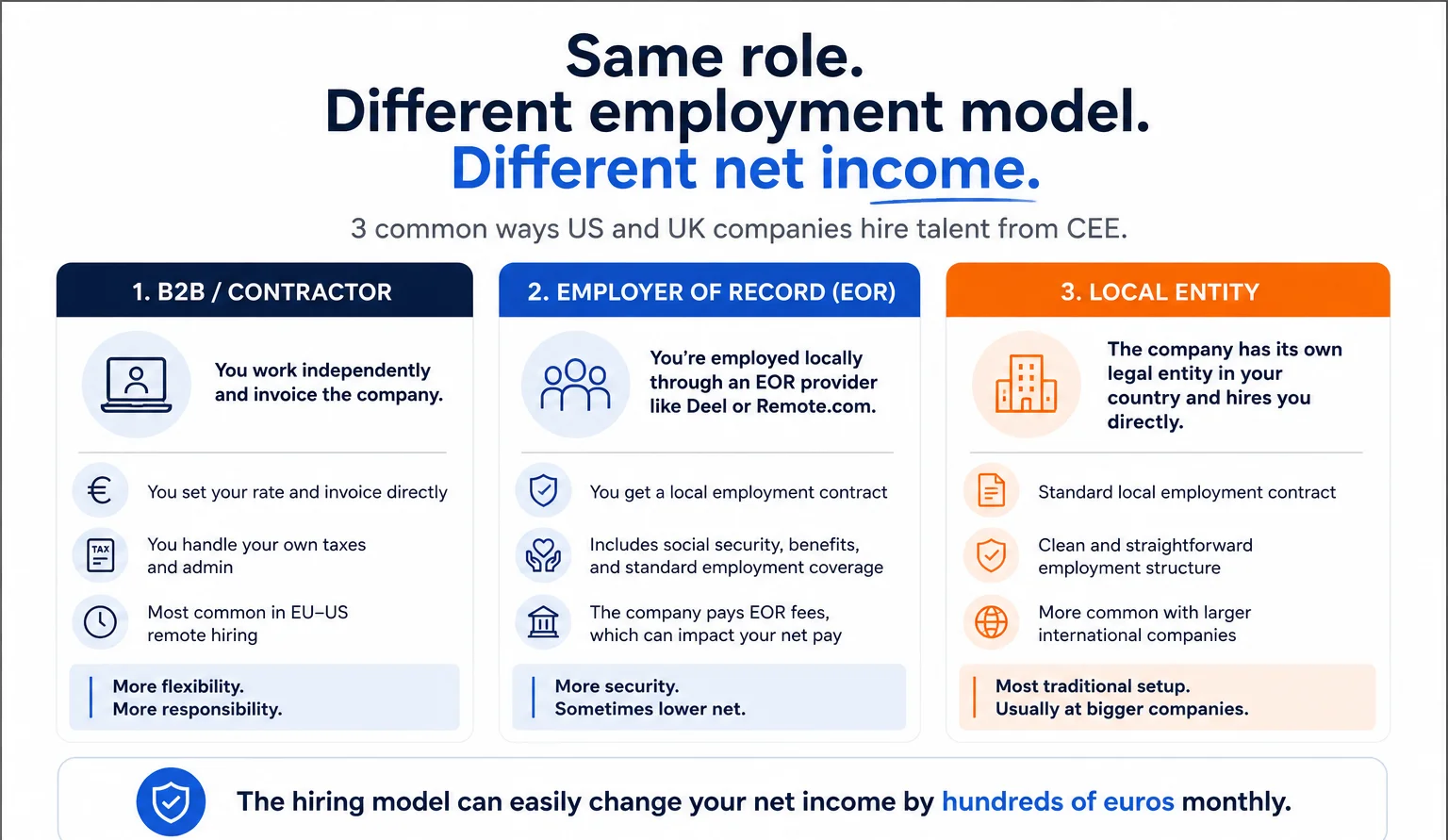
For a company outside your country to pay you for remote work, one of three things has to be true:
You work as a contractor and invoice them (B2B)
A third-party employer hires you locally on their behalf (Employer of Record)
The company has a legal entity in your country
That's it. There's no fourth option. If none of these applies, the company can't legally employ you, regardless of what the job listing says.
B2B / contractor
This is how most EU-to-US remote work is structured.
You register as a freelancer or set up a sole trader entity. The company signs a services agreement with you. You invoice them monthly — typically in USD or EUR. You handle your own taxes, social security, and anything else that comes with being self-employed.
The upside: you control your rate. You're not capped by a local salary band. The rate often reflects Western market norms, not Central European ones.
The downside: no paid leave, no sick pay, no employer pension contributions. You carry all of that yourself. In countries like Hungary or Poland, that means factoring in self-employment costs when you negotiate your rate.
Most developers doing EU-to-US remote work know this setup. But it's worth confirming early in the process that some US companies have policies against contractor arrangements in certain countries, often due to misclassification risk on their side.
Employer of Record (EOR)
An Employer of Record is a company — like Deel, Remote.com, or Rippling — that employs you locally on behalf of the foreign company.
The foreign company pays the EOR. The EOR employs you under a standard local employment contract in your country. You get the same legal protections as any local employee: paid leave, social security, proper notice periods.
The EOR model has grown fast since 2020. It solved the "we want to hire you but can't legally" problem for thousands of companies.
A few things to know going in:
EOR fees are real. The company pays them, but in practice some companies factor them into the package they offer you. Your net pay may be slightly lower than a direct B2B arrangement at the same gross rate.
Not all EORs cover every country. Most of the major ones (Deel, Remote.com) cover all eight CEE countries in this region. Smaller EORs may not. Worth checking if the company mentions a specific provider.
You still negotiate your rate. The EOR is the legal wrapper, not the salary decider. That conversation is with the foreign company.
Local entity employment
The cleanest setup — and the rarest one for smaller companies.
The foreign company has a registered subsidiary in your country. They hire you as a regular employee under local labor law. Payroll runs locally. Benefits work like any local employer.
You'll see this most often with larger US or UK companies that have been operating in CEE for years — established product companies, consulting firms, tech-focused enterprises. A startup with 15 people in San Francisco almost certainly doesn't have a Polish or Romanian entity.
If it exists, it's usually a sign the company is serious about building a team in the region.
What to ask — and when
The right time to ask is before you invest serious time in the process. Not at the offer stage. Not after the final interview.
A simple way to frame it:
"Are you set up to hire engineers in Poland [or your country] — as contractors, through an EOR, or via a local entity?"
A company that has hired remotely from the region before will answer this in one sentence. A company that hasn't may need to check. That pause tells you something too.
If they come back and say "we're still figuring out the legal setup" — that's not always a dealbreaker. Some companies are genuinely learning. But it means more uncertainty, a longer timeline, and a real chance the process ends without an offer.
Red flags worth knowing
The listing says remote but doesn't mention contract type. This is common. It's not always a red flag — many companies just don't think to specify. Ask.
"We'll handle it somehow." Companies that have done cross-border hiring know exactly how they do it. Vague answers here usually mean they haven't done it before.
They want to run it through a "consulting agreement" with no formal structure. Not all B2B arrangements are created equal. A proper services agreement protects you both. If they're vague about what they're actually signing, slow down.
The company is in the US and wants to pay in local currency. Legitimate remote roles for US companies pay in USD or EUR. Local currency payments from a foreign company without a local entity is a messy setup.
Why this matters more in CEE
The legal complexity of cross-border hiring hits harder here than in Western Europe.
Germany, France, and the Netherlands have attracted enough foreign companies that most hiring managers know the EOR setup by heart. Central and Eastern Europe is still catching up. Companies that have never hired outside their home country may not even know what an EOR is when you first bring it up.
That's changing. The region's developer density — combined with several years of remote-first hiring norms — means more companies are learning the legal setup for CEE. But it's still worth going in informed.
At CEEhire, I check the legal setup of every job before it goes live. If the company can't tell me whether they hire through B2B, EOR, or a local entity — the listing doesn't get posted. Not because they're dishonest, but because an unresolved legal question at the hiring stage is a problem for the developer at the offer stage.
You deserve to know before you apply.
Related posts

What do current DevOps listings on CEEhire actually show? Salaries range from €3,400 to €14,000/month depending on company type, and Azure is just as active as AWS in CEE-accessible roles. Here's the breakdown.
Nearly 40% of job listings aren't actually open. Here's what a ghost job is, how to spot one, and why it matters if you're job hunting in Central and Eastern Europe.

We built CEEhire because finding remote IT jobs that are actually open to professionals in Central and Eastern Europe was harder than it should be. Every listing on CEEhire is checked. Real jobs, real companies, actually remote from the region.