
Hiring someone in another country sounds simple until you get into the details.
You find the right person, agree on a salary, and then discover that you need to understand local employment law, payroll, taxes, social security, benefits, employment contracts, paid leave and termination rules.
And that is exactly where an Employer of Record (EOR) can help.
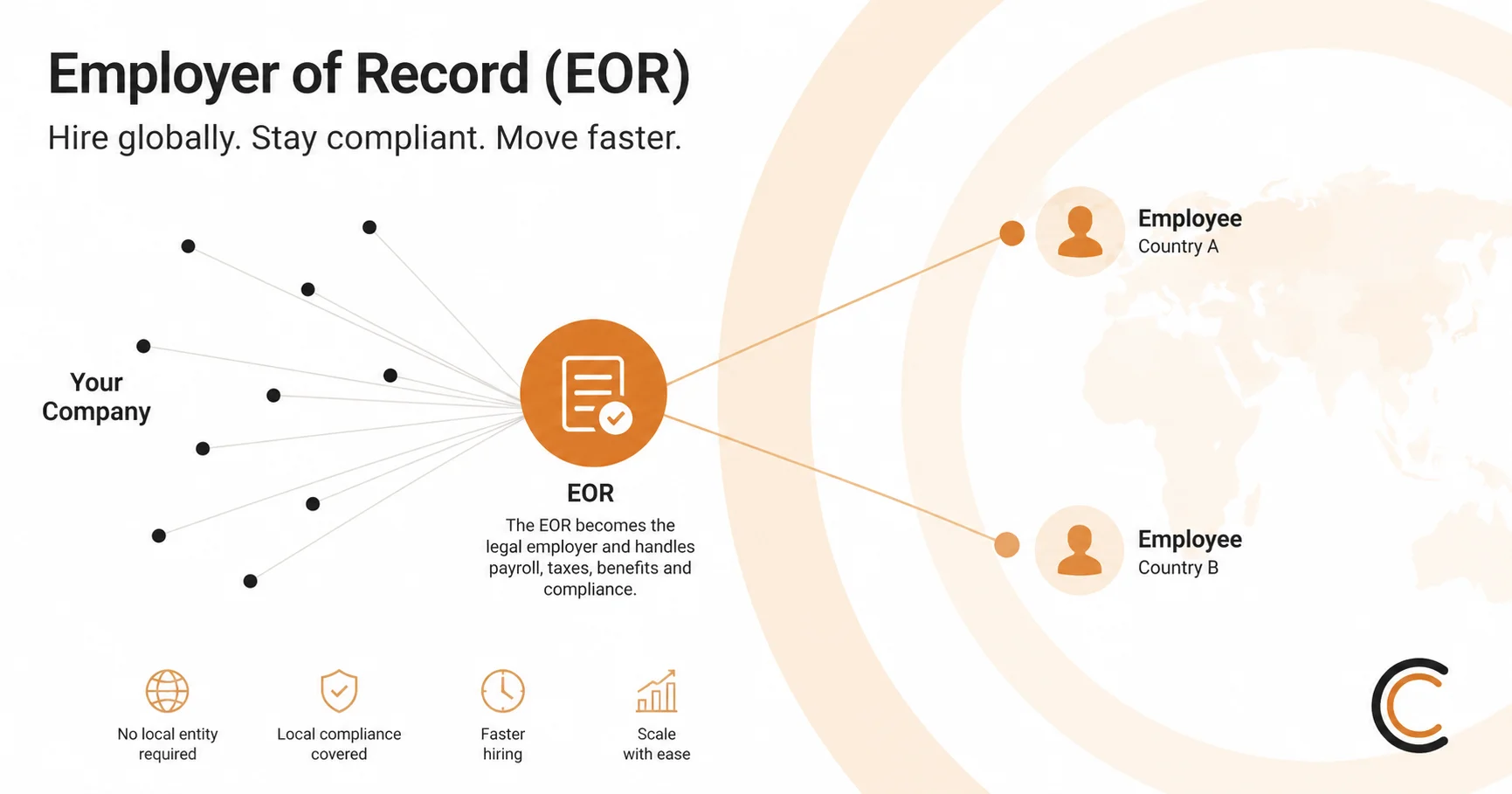
An EOR allows a company to hire an employee in another country without setting up its own legal entity there. The EOR becomes the employee's legal employer and takes care of local employment administration, payroll and compliance, while the client company still manages the employee's day-to-day work.
For companies hiring remote talent across Central and Eastern Europe, this can be a particularly useful model.
But an EOR is not automatically the best solution. It can be expensive, it adds another company to the employment relationship, and there are situations where setting up your own entity or hiring a contractor makes more sense.
This guide explains how EOR works, when it is worth considering, its main advantages and disadvantages, and some of the leading EOR providers in 2026.
What is an Employer of Record?
An Employer of Record is a third-party company that legally employs a worker on behalf of another company.
The distinction between the legal employer and the company the employee actually works for is important.
Imagine a US software company wants to hire a developer who lives in Hungary.
The US company does not have a Hungarian legal entity.
Instead of establishing one, it can work with an EOR.
The structure looks roughly like this:
US company → EOR → Hungarian employee
The EOR employs the developer under a locally compliant employment contract and takes care of things such as:
Payroll
Employment taxes
Social security contributions
Mandatory benefits
Employment contracts
Local employment compliance
Leave administration
Certain HR administration
Termination processes
The employee still works for the US company in practical terms. Their manager, responsibilities, projects and everyday work are determined by the US company.
The EOR handles the legal employment side.
This is one of the main reasons EOR services have become popular as companies build international and remote teams.
How does an EOR work?
The process is fairly straightforward.
1. The company finds the employee
The company handles recruitment and decides who it wants to hire.
For example, a German SaaS company finds a software engineer in Romania.
2. The company chooses an EOR
The employer checks whether an EOR supports the employee's country and whether its pricing and employment model make sense.
3. The EOR creates the local employment arrangement
The EOR prepares the employment contract according to the country's employment laws.
The contract needs to reflect local requirements around things such as salary, working time, leave, benefits and termination.
4. The employee is onboarded
The employee signs the local employment contract and provides the required documentation.
5. The company manages the employee
The employee works for the client company just as any other team member would.
Their manager, projects and daily responsibilities remain with the client company.
6. The EOR handles payroll and compliance
The EOR processes payroll, handles required filings and manages the local employment administration.
This is where most of the complexity is removed from the employer.
Why would a company use an EOR?
The biggest reason is simple:
You want to hire someone in a country where you don't have a legal entity.
Setting up a foreign entity can involve legal work, accounting, payroll infrastructure, tax registration and ongoing administration.
An EOR lets a company start hiring without going through that process.
This can be especially useful when a company is:
Hiring its first employee in a new country
Building a distributed remote team
Testing a new market
Hiring specialist talent that is difficult to find locally
Expanding into several countries at the same time
Not yet sure whether it needs a permanent local entity
An EOR can also make international expansion faster because the company does not have to establish its own local employment infrastructure before making the first hire.
The main advantages of using an EOR
1. You don't need to set up a local entity
This is probably the biggest advantage.
If a company wants to hire one developer in Hungary, opening a Hungarian subsidiary just for that employee may not make much sense.
An EOR already has the infrastructure needed to employ people locally.
That means the company can hire without establishing its own entity.
2. International hiring can be much faster
Setting up an entity takes time.
There can be company registration, bank accounts, tax registration, payroll setup and other administrative steps before the first employee can even be hired.
With an EOR, much of that infrastructure already exists. Some providers advertise onboarding times measured in days rather than weeks or months, although the actual timeline depends on the country and the employee's situation.
For a company competing for a strong software engineer, this can matter.
A candidate who is ready to start next month may not want to wait while the employer spends weeks establishing a legal entity.
3. Local employment compliance is easier
Employment law varies considerably between countries.
Rules around:
notice periods
paid holidays
sick leave
mandatory benefits
social security
payroll taxes
employment contracts
probation
termination
parental leave
can all be different.
An international company does not necessarily have the expertise to manage these requirements in every country where it hires.
The EOR provides local employment infrastructure and compliance support, reducing the amount of work the employer has to manage itself.
That doesn't mean the company can ignore employment law completely. It still needs to understand what it is buying and what responsibilities remain with it.
4. It makes remote hiring easier
For remote-first companies, EORs solve a very practical problem.
You might find an excellent developer in:
Hungary
Poland
Romania
Czechia
Slovakia
Croatia
Serbia
without necessarily having a legal entity in every country.
Instead of limiting recruitment to countries where you already have infrastructure, an EOR can make a wider talent pool accessible.
This is one reason EOR services fit particularly well with distributed teams.
5. It can be useful for testing a new market
Not every international expansion deserves a subsidiary immediately.
A company might want to hire two people in a country and see how things develop first.
An EOR provides a relatively low-commitment way to establish a local employment presence.
If the company eventually builds a substantial team in that country, it can decide whether establishing its own entity makes economic sense.
In other words, an EOR can be a bridge between having no local presence and building a permanent operation.
The disadvantages of using an EOR
EORs solve real problems, but they aren't free.
And for some companies, they aren't the right long-term solution.
1. EORs can be expensive
The biggest drawback is the additional cost.
The employer pays:
Employee salary + employer costs + EOR fee
The EOR fee is normally charged per employee, per month, although pricing models vary.
For example, current advertised pricing from major providers includes around $599 per employee/month for Deel and $699 per employee/month for Oyster and Remote, although actual costs can vary by country, package and agreement. (Pricing checked August 2026 — always confirm current rates directly with the provider before quoting them to a client, as these change.)
That can be reasonable if you're hiring one or two people.
But if you're employing 50 people in the same country, the calculation becomes different.
At that point, establishing your own entity may be financially more attractive.
2. You don't have complete control over the employment infrastructure
The EOR becomes part of the employment setup.
That can introduce another layer between your HR team and your employee.
The EOR may control parts of:
payroll
employment documentation
benefits administration
onboarding
offboarding
local HR processes
For most companies this is manageable, but it can create friction when something unusual happens.
3. Country-specific limitations still exist
An EOR doesn't magically remove local employment law.
Every country has its own rules.
Some employment arrangements, benefits, equity plans or termination processes may be more complicated than others.
This is particularly relevant when hiring senior employees, offering stock options or dealing with unusual compensation structures.
You should always check exactly what the EOR supports in the country where you're hiring.
4. The economics become less attractive as your team grows
An EOR is often attractive when you're hiring a small number of employees internationally.
But imagine you eventually have:
30 employees × $600/month EOR fee
That's $18,000 per month before considering salaries and other employment costs.
At that scale, establishing your own entity may start to make more financial sense.
The exact break-even point depends heavily on the country and the costs of setting up and maintaining a local entity.
EOR vs. contractor: what's the difference?
This is one of the most important distinctions when hiring internationally.
A company might think:
"Why don't we just hire this person as a freelancer?"
Sometimes that's perfectly reasonable.
But not always.
A contractor is generally an independent business providing services to the company.
An EOR employee is legally employed by the EOR.
The problem arises when a company treats someone like an employee but classifies them as a contractor.
This can create worker misclassification risk.
For example, if the person works full-time, follows the company's working hours, reports to a manager, receives ongoing instructions and operates essentially like an employee, simply calling them a contractor does not necessarily make the arrangement legally compliant.
An EOR can be useful when the company wants a genuine employment relationship without setting up a local entity.
EOR vs. setting up your own entity
This is usually the bigger strategic decision.
EOR | Own entity | |
|---|---|---|
Setup | Fast | More involved |
Upfront cost | Lower | Higher |
Local compliance | EOR manages much of it | You manage it |
Control | Lower | Higher |
Cost per employee | Usually higher | Can be lower at scale |
Best for | Small teams / market testing | Larger permanent teams |
Expansion speed | Fast | Slower |
Local infrastructure | Provided by EOR | You build it |
If you're hiring your first employee in a country, an EOR can be very attractive.
If you know you're going to employ hundreds of people there, building your own entity may eventually be the better option.
The biggest EOR providers in 2026
There are now quite a few companies in the global employment market.
Three names you'll come across frequently are Deel, Remote and Oyster.
Other providers include Papaya Global, Rippling, Multiplier and several regional specialists.
Here's a quick look at some of the better-known options.
Deel
Deel is one of the most recognizable names in global employment and payroll.
Its EOR service currently supports 130+ countries, according to the company, and its advertised EOR price starts at $599 per employee per month.
Good fit for:
Startups hiring internationally
Remote companies
Companies hiring across multiple countries
Businesses that want a broader global HR platform
One advantage is that Deel doesn't only offer EOR. Companies can also use it for contractors, payroll and other global workforce processes.
Remote
Remote focuses heavily on international employment and distributed teams.
It offers EOR, contractor management and global payroll solutions.
Good fit for:
Remote-first companies
International teams
Companies hiring across several countries
Businesses looking for an all-in-one global employment platform
Remote is particularly well known in the remote work ecosystem.
Oyster
Oyster is another major player in global employment, with a strong focus on distributed and remote teams.
Its current EOR pricing starts at $699 per employee/month, according to its published pricing information.
Good fit for:
Remote-first companies
Distributed teams
Companies that put emphasis on employee experience
Businesses looking for transparent pricing
Oyster currently advertises EOR coverage in 120+ countries.
Papaya Global
Papaya Global is another established player in global workforce management, with a strong focus on payroll, workforce management and international employment infrastructure.
It can be particularly relevant for companies managing larger international workforces rather than simply hiring their first overseas employee.
Which EOR should you choose?
There isn't one universally best EOR.
The right choice depends on where you're hiring, how many people you plan to hire and what type of workforce you have.
I'd look at at least these factors before choosing a provider:
Country coverage
Don't just look at the total number of countries supported.
Check whether the provider has a strong setup in the specific countries where you're hiring.
Total cost
Look beyond the advertised monthly fee.
Check:
onboarding fees
offboarding fees
benefits
currency conversion
additional HR services
contract amendments
equity support
other country-specific charges
Compliance model
Ask who actually employs the worker and whether the provider owns its own local entity or relies on partners.
Benefits
Benefits can vary significantly between countries and providers.
Support
When something goes wrong with payroll or employment documentation, you want to know who will actually help.
Contract flexibility
If you're testing a market, flexibility can be more valuable than getting the lowest possible monthly price.
Is an EOR worth it?
For many companies, yes.
But I'd frame it this way:
An EOR is a tool for reducing complexity, not necessarily reducing the total cost of employment.
You're paying the EOR because building and maintaining the employment infrastructure yourself also costs money.
If you're hiring one developer in Hungary, paying an EOR fee may be much easier than establishing and maintaining a Hungarian entity.
If you're hiring 100 people in Hungary, the economics may look very different.
The same applies to Poland, Romania, Czechia and other CEE markets.
The right question isn't:
"Is an EOR expensive?"
It's:
"Is the EOR fee lower than the cost and complexity of building this infrastructure ourselves?"
That's the calculation that actually matters.
When should you use an EOR?
An EOR is worth considering when:
You want to hire internationally without setting up a local entity
You're hiring your first employee in a country
You're building a remote team
You want to test a new market
You need local employment compliance support
You don't have an international HR/payroll team
You want to move quickly
It may not be the best option when:
You already have a local entity
You're hiring a large team in one country
You need maximum control over employment operations
A contractor arrangement is genuinely appropriate
Your EOR costs are significantly higher than maintaining your own entity
Final thoughts
EOR services have made international hiring considerably easier.
A company in the US can hire a developer in Hungary. A German startup can build a team in Poland. A UK company can hire someone in Romania without immediately creating a local subsidiary.
That flexibility is the main reason the EOR model has become so popular.
But an EOR shouldn't be treated as a default solution for every international hire.
For a small distributed team, the convenience and reduced administrative burden can easily justify the monthly fee. For a large, established operation in one country, setting up your own entity may eventually be more economical.
If you're hiring remotely across Central and Eastern Europe, the best approach is usually to compare EOR vs contractor vs local entity for each specific country and hiring situation rather than assuming one model works everywhere.
Looking for remote jobs in Central and Eastern Europe? Browse the latest opportunities on CEEhire.
Related posts
More than 133,000 tech workers have been laid off in 2026, already above all of 2025. Yet US software job postings are up about 20% year on year. The market isn’t collapsing, it’s sorting: generalists are getting cut, specialists are getting hired. Here’s what the data means for engineers in Central and Eastern Europe, and three moves to make now.

AI hiring is changing Agentic AI isn’t the only area seeing strong growth. Demand for GenAI Solutions Architects and AI Product Owners increased by 120%, while demand for LLM Engineers rose by 86.5% and MLOps Engineers by 82.2%. At the same time, AI is taking over more routine technical work. According to the analysis, it can already handle up to 70% of routine ticket resolution and reporting tasks and automate around 65% of test-case creation.

Job boards are getting harder to use for both recruiters and candidates. AI tools now apply to jobs automatically, and the usual fix, building a local network and showing up in person, gets a lot harder once the candidate and the company are in different countries.