
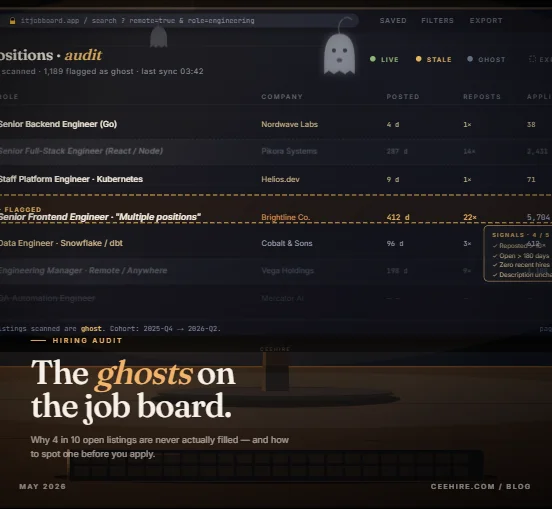
Poland · Hungary · Czechia · Slovakia · Romania · Bulgaria · Croatia · Slovenia
You spend an hour writing a cover letter. You tailor your CV. You hit submit.
Then nothing. Not a rejection. Not an automated reply. Nothing.
Two weeks later the listing is still up. You wonder if something went wrong with your application. It didn't. The job was never real.
This is the ghost job problem — and it's bigger than most people realise.
What a ghost job actually is
A ghost job is a listing that looks active but has no real intent behind it. The company isn't hiring. The role doesn't exist yet, or was already filled, or was quietly frozen after the listing went up.
Industry surveys put the scale of this at around 40%. Nearly four in ten managers have admitted their company kept an active listing live when there was no actual open position behind it.
Why companies do it
It seems irrational to post jobs you're not hiring for. But companies have their reasons — and they're rarely malicious. More often they're just not thinking about the applicant's time at all.
Building a talent pool. This is the most common reason, accounting for roughly 45% of ghost job postings. The company isn't hiring today but wants a pipeline for when they are. So they run a listing, collect CVs, and file them. You applied to a database, not a job.
Looking like a growing company. A careers page full of open roles signals momentum — to investors, to clients, to prospective employees. The listings themselves are part of the branding. Whether they result in hires is secondary.
Keeping overworked teams quiet. A manager with a burned-out team posts a role to signal that help is coming. Then budget gets cut. The listing stays up because no one thinks to take it down.
Forgotten admin. Sometimes it's just that no one closed the listing after the role was filled. Most job boards don't expire postings automatically. A three-month-old role sits there looking fresh because the system never removed it.
How to spot one before you apply
A real job moves. A ghost job just sits there.
The clearest signal is time. Real positions get filled in an average of 42 days. Ghost job listings stay active for an average of 180 days — more than four times as long. If a listing has been up for two months with no changes, that's a flag.
A few others worth checking:
The listing reappears regularly. Some platforms auto-repost every 30 days to keep listings looking fresh. If you've seen the same role from the same company three times in four months with identical text — it's probably not moving.
The job description is generic to the point of meaninglessness. "We're looking for a passionate team player who thrives in a fast-paced environment." No tech stack. No team size. No actual role context. Listings written to attract CV submissions rather than actual candidates tend to look like this.
The company's public signals don't match. They announced layoffs last quarter. Their LinkedIn shows no new employees in the last six months. But they have eight open roles. The math doesn't add up.
No reply for weeks after applying. Real hiring processes move imperfectly but they move. If three weeks have passed with no acknowledgement at all — not even an automated one — the listing probably isn't active.
What to do about it
You can't fully avoid ghost jobs, but you can waste less time on them.
Check the posting date first. Anything older than 30–45 days without an update deserves extra scrutiny before you invest time in a full application. If you can't find a clear date, that's a flag in itself.
Look at the company's LinkedIn activity. Are they actually growing? Do recent employees show up? Have they posted any hiring-related content? A company genuinely hiring usually leaves some trace of it.
Find a direct contact before applying. Search for the recruiter or hiring manager on LinkedIn. A short message asking whether the role is still active takes two minutes and saves you an hour. Most people will answer — and the answer tells you what you need to know.
If the listing looks suspicious but you still want to apply, standardise your effort. Use a solid baseline CV and cover letter. Don't invest three hours in a role that might be a database-building exercise.
Why this matters more for developers in Central and Eastern Europe
Remote job boards make the ghost job problem worse for developers in the region.
When a company in the US or UK posts a "remote" role on a global platform, the listing gets applications from 80 countries. Many of those applicants are irrelevant — wrong timezone, wrong legal setup, wrong skill level. The company has no urgency to respond to anyone because the volume is unmanageable.
Meanwhile, a developer in Warsaw or Budapest spent an evening on that application. And the company was never going to reply regardless of how good the CV was.
At CEEhire, one of the things I check before any job goes live is whether the listing is current and active. If the role was posted 60 days ago and shows no signs of movement, it doesn't go on the board. If I can't verify the company is actively hiring, it doesn't go up.
That's a manual process. It's slower than running an aggregator. That's the point.
Fewer jobs. All of them actually open.
Related posts

AI hiring is changing Agentic AI isn’t the only area seeing strong growth. Demand for GenAI Solutions Architects and AI Product Owners increased by 120%, while demand for LLM Engineers rose by 86.5% and MLOps Engineers by 82.2%. At the same time, AI is taking over more routine technical work. According to the analysis, it can already handle up to 70% of routine ticket resolution and reporting tasks and automate around 65% of test-case creation.
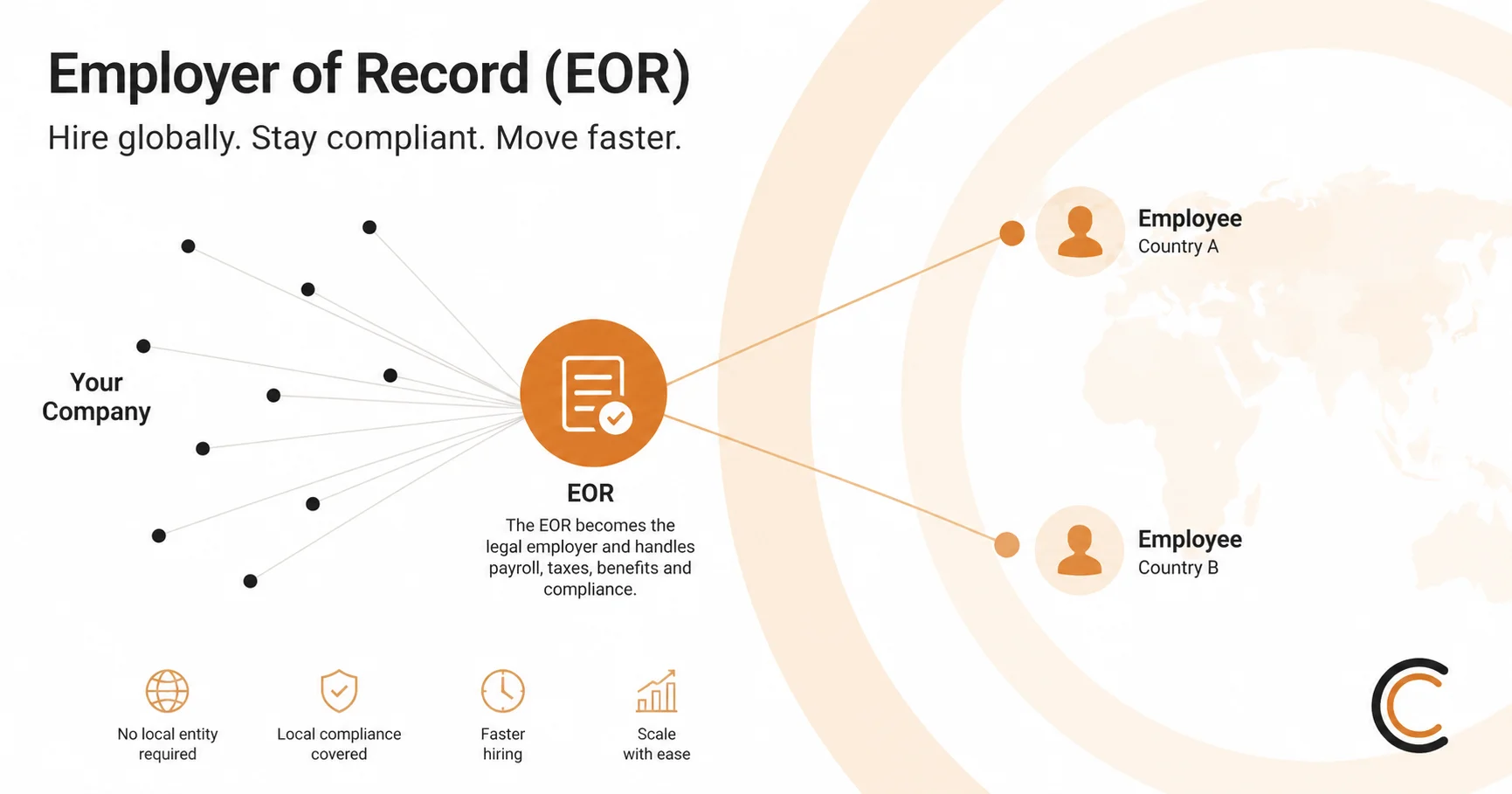
What is an Employer of Record, how does it work, and when does it actually make sense for hiring CEE tech talent? A practical 2026 guide — plus the leading EOR providers compared.
Job boards are getting harder to use for both recruiters and candidates. AI tools now apply to jobs automatically, and the usual fix, building a local network and showing up in person, gets a lot harder once the candidate and the company are in different countries.